
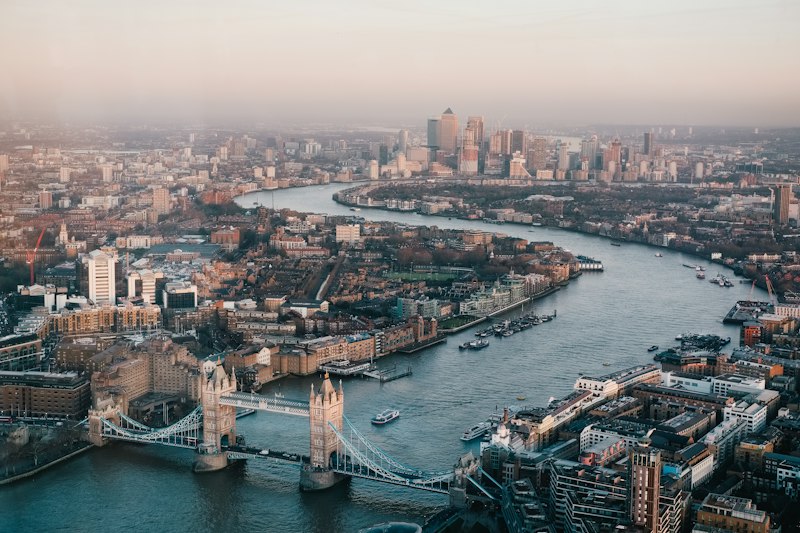
A Watershed Moment for London's Urban Enterprise
The announcement today of a £2.5 billion public-private partnership to create a 12-mile 'Innovation Corridor' stretching from the City of London to the Thames Estuary marks what city planners and economists are calling a 'once-in-a-generation' shift in metropolitan business development. The project, officially unveiled this morning by the Mayor of London and a consortium of investors including Blackstone, Legal & General, and the Sovereign Wealth Fund of Norway, promises to transform underutilized commercial real estate, foster small business innovation, and cement London's position as a global hub for green technology and fintech.
At the heart of the plan is the creation of five new 'Urban Enterprise Zones' (UEZs) along the corridor, each designed to specialize in a distinct sector: clean energy, artificial intelligence, biotechnology, advanced manufacturing, and digital finance. These zones will offer tax incentives, streamlined planning permissions, and subsidized rent for startups and scale-ups, alongside dedicated innovation centers and co-working spaces. The first zone, in Stratford, is expected to break ground within six months.
'This is not just a development; it's a reimagining of how a modern metropolis can drive economic growth from the ground up,' said Dr. Amelia Hartley, chief economist at the London School of Economics and a member of the project's advisory board. 'We are looking at a potential 15% increase in GDP contribution from the East End over the next decade, with tens of thousands of new high-skilled jobs.'
The commercial real estate implications are staggering. Vacant industrial sites, former docklands, and underused retail parks will be repurposed into mixed-use hubs featuring office space, laboratories, affordable housing, and green public realm. 'This is the largest brownfield regeneration project in Europe,' noted Marcus Chen, managing director of CBRE's London office. 'It will unlock billions in property value and create a new paradigm for urban commercial development. We're seeing institutional investors pivoting hard toward impact-driven real estate.'
Small business innovation is a key pillar. The project includes a £500 million 'Innovation Fund' offering grants and venture capital to startups that locate within the UEZs, with a focus on firms that can contribute to the city's net-zero targets. 'For too long, small businesses in London have been priced out of prime locations,' said Sarah Jenkins, founder of TechEast, a network of East London tech startups. 'This corridor gives them a permanent home with the infrastructure to grow. It's a game-changer.'
The metropolitan economic outlook, already buoyed by London's resilience post-pandemic, is now decidedly bullish. The Office for Budget Responsibility has projected that the corridor could add 0.7% to UK GDP annually by 2030. 'This is exactly the kind of bold, long-term thinking needed to rebalance the UK economy,' said former Chancellor of the Exchequer, Lord Philip Hammond, in a statement. 'It leverages private capital to deliver public good.'
However, critics warn of potential gentrification and displacement of existing communities. The Mayor's office has pledged that 35% of new housing within the corridor will be 'affordable,' but housing activists remain skeptical. 'We've heard these promises before,' said Maria Torres of the East London Housing Coalition. 'We need legally binding commitments, not just targets.'
The project also faces logistical hurdles. Integrating five disparate zones across multiple boroughs—each with its own planning authority—will require unprecedented coordination. A new 'Corridor Development Corporation' has been established to streamline decision-making, with powers to override local objections in the national interest.
Despite these challenges, the momentum is undeniable. 'This is a watershed moment for metropolitan economic development,' said Professor James Whitfield, director of the Urban Policy Institute at King's College London. 'It signals a shift from piecemeal regeneration to strategic, corridor-level thinking. If successful, it will become a template for cities worldwide.'
Why This Matters
The Innovation Corridor is more than a real estate play; it is a test case for how cities can harness globalization, technology, and sustainability to create inclusive growth. As metropolitan areas compete for talent and investment, London's model of combining public vision with private capital could redefine urban enterprise. For businesses, investors, and policymakers, the message is clear: the future of the metropolitan economy is being built today, brick by brick, in the east of London.